There’s a tendency when we talk about the tabernacle to get a little… hesitant.
“This could mean this.”
“Maybe this represents that.”
And on some level, that caution makes sense. The tabernacle is layered. It’s detailed. It’s symbolic in ways that stretch across the whole story of Scripture.
But sometimes “could” isn’t humility—it’s uncertainty where there doesn’t need to be any.
Because what the tabernacle represents…
does mean what Scripture reveals it to mean.
We’ve been walking through this over the past few weeks in our Wednesday evening Bible study. And once you slow down—really slow down—and dig into the text, you start to see just how much God is communicating.
Some of it is straightforward.
Some of it is layered.
And a lot of it is many different things at the same time.
That’s what’s been so striking.
These elements don’t just point to one thing—they often carry multiple, connected meanings.
Take the lampstand, for example. It points to Christ. It reflects the work of the Holy Spirit. And it even echoes imagery from the garden of Eden—all at the same time.
There’s a lot. More than we can unpack in one sitting.
So instead of trying to explain everything…
Let’s slow down and look at a few concepts…
A Complex God, A Complex Dwelling
The tabernacle isn’t random.
It’s not decorative.
It’s not God experimenting with interior design.
It’s intentional—because it represents something profound:
A holy, complex God choosing to dwell with His people.
And when something that significant is being revealed, symbolism isn’t vague—it’s precise and multifaceted.
The Table Isn’t Just a Table
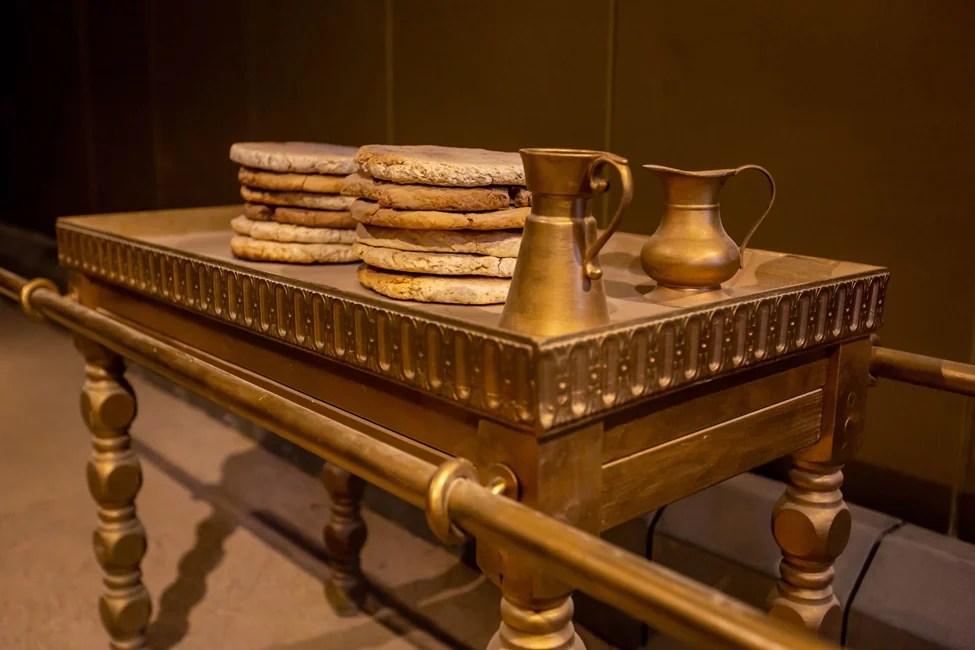
Take the Table of Showbread.
Yes—it points forward to Jesus as the Bread of Life.
That’s true. That’s real. That’s important.
But if that’s all we see, we’ve actually missed part of what God was saying.
That table was also a living testimony to Israel:
- God is your provider
- God sustains you
- God has already proven Himself faithful
Because the bread on that table didn’t appear in a vacuum.
It echoed something they had lived:
Manna in the wilderness.
The table didn’t just point forward to Christ.
It pointed backward to provision.
And it stood in the present as a reminder:
You are still being sustained by God.
Why Only Three Pieces?
Before the coverings… before the outer structure… before all the layers…
Scripture focuses on three pieces of furniture in Exodus 25:
- The Ark
- The Table
- The Lampstand
That’s not accidental.
Because the story doesn’t begin with what we expect.
It doesn’t begin with:
- sin
- sacrifice
- fixing what’s broken
Those come later:
- The altar of sacrifice — Exodus 27
- The altar of incense — Exodus 30
And the incense altar shows up after instructions about the priests.
So what’s happening?
God Starts From His Side
The tabernacle doesn’t begin with:
“Here’s how you deal with your sin.”
It begins with:
“Here’s where I dwell.”
That shift matters more than we usually realize.
Because it reveals something foundational:
Access to God doesn’t start with us.
It starts with Him.
God establishes first:
- His presence (the Ark)
- His provision (the Table)
- His light (the Lampstand)
Then He shows how we approach Him.
Before the Fix… the Location
We often want God to start with solutions.
- Fix this
- Forgive that
- Repair what’s broken
But that’s not where He starts.
Before God ever explains the process of atonement…
Before He outlines sacrifice…
Before He addresses sin…
He reveals His location.
“Here I Am.”
That’s the pattern you see not just in Exodus—but echoed again in Jesus coming into the world.
God doesn’t begin with distance.
He begins with presence.
Why That Changes Everything
The reality is – if you start with sin, you assume the relationship is defined by failure.
But if you start with presence…
You realize the relationship is defined by God’s desire to be near. You see “God is not willing that any should perish” but all should know he desires to dwell with them eternally.
That reframes everything.
You’re not trying to earn your way into a distant space.
You’re being invited into a place where God has already chosen to dwell.
It’s Personal…
We use the phrase “it’s personal” in a very specific way.
It means something crossed a line.
Something hit deeper than it should have.
And now… we’re not just responding—
we’re reacting.
Because now it’s personal.
Now it’s about getting even.
Now it’s about making it right.
Now it’s about striking back.
That’s how we operate.
But that’s not how God operates.
When it comes to our sin, God doesn’t respond the way we do.
He doesn’t get defensive.
He doesn’t withdraw.
He doesn’t strike back.
He doesn’t say, “You’ve offended me—now you need to fix this.”
Instead…
He moves toward us.
Think about that.
If anyone had the right to take sin personally the way we do—it would be God.
But He doesn’t.
He doesn’t make it about His wounded pride.
He doesn’t build distance.
He doesn’t demand repayment before relationship.
He does something completely different.
He shows us where He is.
He establishes His presence.
He makes a way to dwell among His people.
And then…
He shows us how sin is dealt with.
That’s the order.
Not:
Fix yourself → then come to God
But:
Here I am → now let me deal with what’s separating us
One Simple, Disruptive Truth
Before God ever tells you how to fix what’s broken…
He shows you where He is.
And once you see that clearly—
the rest of the tabernacle doesn’t get less complex…
But it does get a whole lot more personal.


